Mold Remediation Cost in Gettysburg, PA
Updated
Mold remediation in Gettysburg typically costs $1,125 to $3,750, averaging around $2,300 to $2,400, at roughly $10 to $25 per square foot of affected area. Small, contained jobs, a bathroom ceiling patch or a closet corner, often run $500 to $1,500. Large jobs involving structural framing or whole-house HVAC contamination can reach $10,000 to $30,000 or more. Testing runs $300 to $1,000 on its own. These are typical ranges, not quotes. A real number for your property comes from an inspection. Larger specialty jobs, such as an extensive basement, a crawlspace, or whole-house contamination, run above this typical band, as the job-type breakdown below shows.
Get a free estimate for your property
Tell us where the mold is and roughly how big the area looks. We'll follow up with next steps and a written number for your home. No obligation.
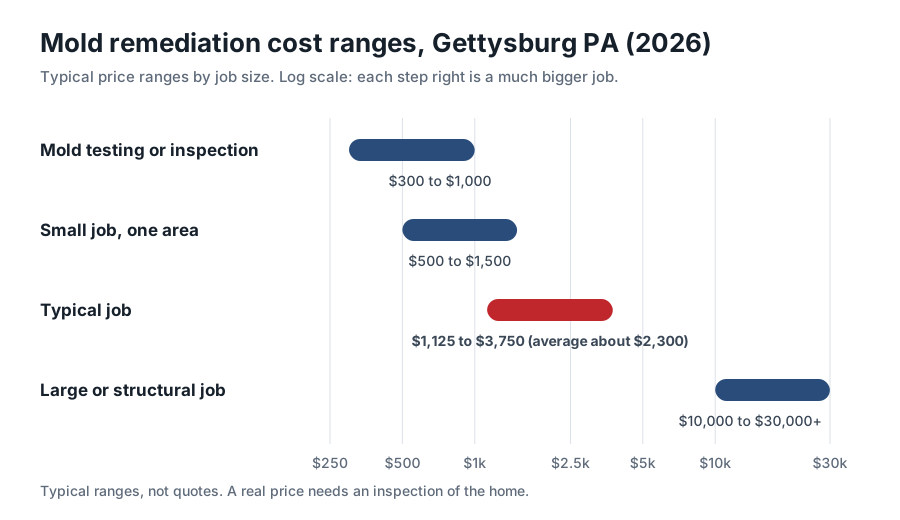
Cost by job type
Every job is priced on square footage, material, and access, but the job type itself is a useful shortcut because it tells you roughly how much area and how much access difficulty you're dealing with before anyone shows up. The ranges below apply the per-square-foot rate above to the area and access conditions typical of each job type in an older Gettysburg-area home. Your actual job may land outside any of these depending on how far the problem has spread.
| Job type | Low | Typical | High |
|---|---|---|---|
| Bathroom (ceiling, tile, grout) | $500 | $900 | $1,500 |
| Attic | $700 | $1,800 | $4,000 |
| Behind drywall, single wall | $800 | $2,000 | $4,500 |
| Basement, one wall or finished room | $1,125 | $2,400 | $6,000 |
| HVAC and ductwork | $1,000 | $2,800 | $6,000 |
| Crawlspace | $1,500 | $3,500 | $8,000 |
| Whole-house or structural | $10,000 | $18,000 | $30,000+ |
These figures assume a straightforward moisture source. A job that also needs plumbing, roofing, or foundation repair to fix the water is priced separately from the remediation itself.
Cost by square footage
Because most contractors price on a per-square-foot basis once a job clears their minimum, here's roughly what that looks like at different sizes, using the $10 to $25 per square foot range. Most companies also carry a minimum job charge, commonly in the $500 to $1,500 band, which is why very small areas don't scale down to almost nothing.
| Affected area | Typical cost |
|---|---|
| Under 10 sq ft (EPA's DIY guideline) | Often within a homeowner's own reach; see below |
| 10 to 50 sq ft | $500 to $1,250, subject to a minimum job charge |
| 50 to 100 sq ft | $1,000 to $2,500 |
| 100 to 250 sq ft | $2,500 to $6,250 |
| 250 to 500 sq ft | $5,000 to $12,500 |
| 500+ sq ft | $10,000 to $25,000+ |
What drives the price
Two jobs with the same square footage can land at very different prices. What actually moves the number is a short list of factors, and none of them is how alarming the growth looks or what species it turns out to be.
- Access. An open basement wall or exposed crawlspace joist is cheap to reach. Behind finished drywall, inside a wall cavity, under a stairway, or in a low crawlspace costs more before any cleaning even starts
- Containment. Larger or more contaminated jobs need sealed plastic containment and negative air machines, which is equipment rental and setup time on top of the labor
- Material removal. Porous material, drywall, insulation, carpet padding, has to come out and be disposed of. Non-porous material like framing, masonry, and tile can often be cleaned in place, which costs less
- HVAC involvement. Contaminated ductwork needs specialized cleaning equipment and adds a separate line item; see our guide on mold in HVAC systems
- Moisture source repair. Frequently a separate trade from remediation. A downspout extension is a small add-on; exterior foundation drainage or a roof repair is not
- Testing and verification. Pre- and post-remediation testing by an independent inspector typically adds $300 to $1,000; see post-remediation verification
- Rebuild. Drywall, insulation, paint, and trim to put the room back together after remediation, priced separately from the mold work itself
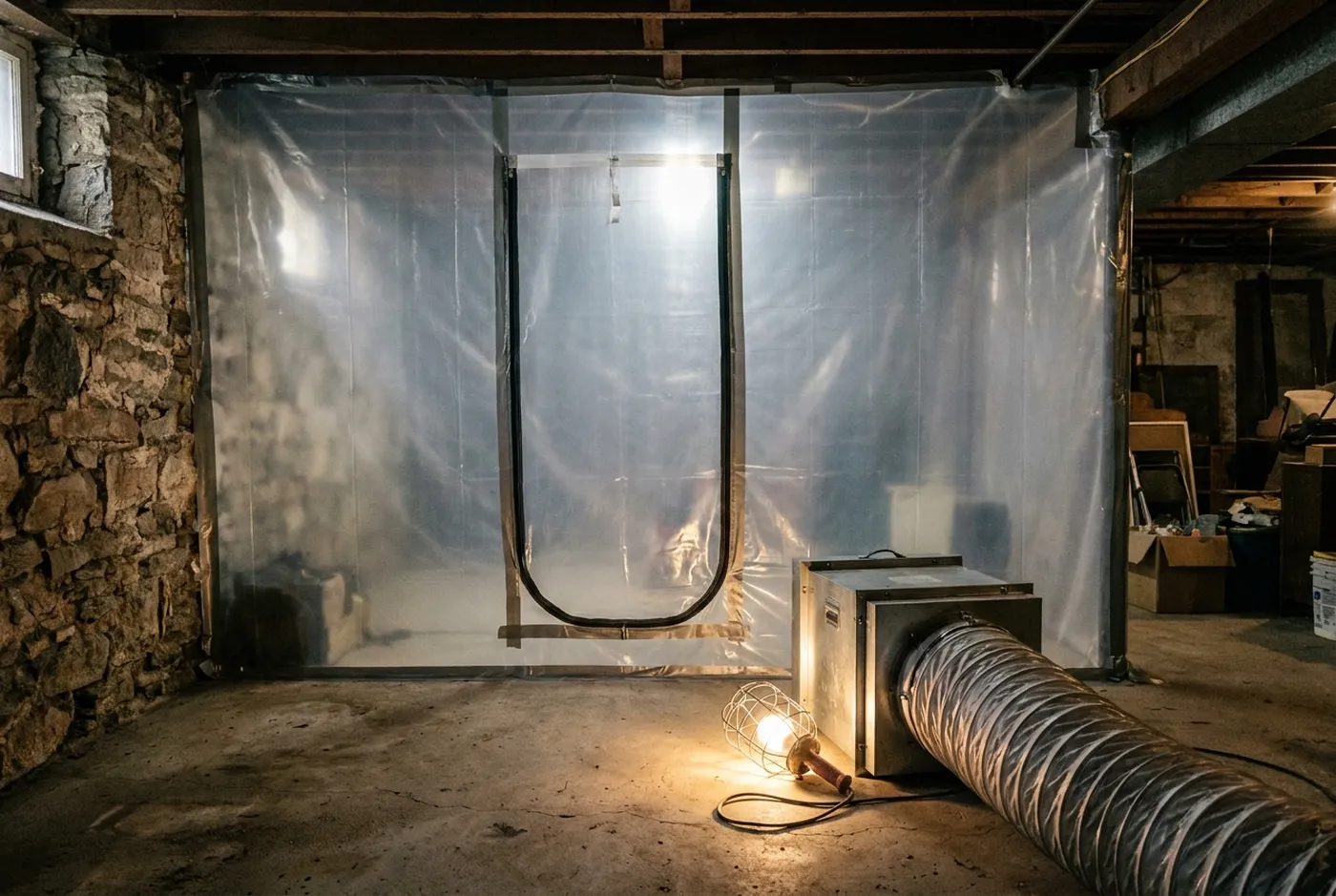
Why older Gettysburg and Adams County homes can cost more
A newer suburban build with a poured concrete foundation and a modern vapor barrier tends to land on the lower end of every range above, because the moisture source is usually localized and easy to reach. Gettysburg and Adams County's older housing stock often works against you on both counts.
- Stone and fieldstone foundations were built without a vapor barrier, so groundwater moisture moves through the stone itself rather than staying outside it
- Balloon-frame construction, common in homes built before the 1930s, creates open stud cavities that run from the basement to the attic, which lets moisture and spores travel further before anyone notices a problem
- Plaster-and-lath walls behave differently than drywall under a moisture meter and take more care, and sometimes more labor, to open and repair correctly
- Gettysburg's historic district and several surrounding boroughs have rules on exterior alterations and visible repairs, which can add a step to a job that touches an exterior wall or a street-facing feature
Taken together, an older stone-foundation home more often means a moisture problem that's had years to spread behind a finished wall before it's noticed, which pushes a job toward the moderate-to-extensive end of the ranges above. See our full guide on historic homes and mold for what this looks like room by room.
Testing and post-remediation verification costs
Testing and remediation are two different services, and not every job needs testing on both ends. A pre-job inspection, sometimes visual only and sometimes with air or surface sampling, typically runs $300 to $1,000 depending on how many samples are taken and whether a lab is involved. Many contractors include a basic visual inspection in the remediation quote itself and only charge separately for lab-confirmed sampling.
Post-remediation verification, sometimes called clearance testing, is a separate inspection, ideally by someone other than the company that did the work, confirming the space is back to a normal fungal ecology before it's closed up or rebuilt. It typically falls in the same $300 to $1,000 range. Skipping it saves money up front and is the single most common way a homeowner ends up paying for the same job twice. See post-remediation verification and mold testing vs. remediation for the full comparison.
Whether testing is worth the added cost usually comes down to what's at stake. A small, obvious patch with a clear water source often doesn't need lab confirmation on either end. A larger job, a job tied to a home sale, or a job where a household member has a respiratory condition is where the extra few hundred dollars for independent verification tends to be worth it.
Does homeowners insurance cover mold remediation?
Coverage generally turns on what caused the water, not on the mold itself. A sudden and accidental event, a burst supply line or a failed appliance hose, is commonly covered. Long-term seepage, groundwater through a foundation, and outside flooding are generally excluded under a standard Pennsylvania homeowners policy. Many policies also cap mold remediation at a sublimit well below the dwelling limit, which is the detail most people discover during the claim rather than before it.
This is general information, not insurance or legal advice, and every policy reads differently. The full breakdown, including what documentation helps a claim, is on does insurance cover mold in Pennsylvania.
DIY vs. professional: the EPA's 10-square-foot guideline
The EPA's A Brief Guide to Mold, Moisture and Your Home puts a rough line at about 10 square feet, an area smaller than a standard shower stall. Below that, a homeowner with gloves, an N95 or better respirator, and basic containment can often clean it up. Above that, or if the growth involves HVAC ductwork, a large wall or ceiling cavity, or has been there long enough that the moisture source is unclear, the guide points toward a professional.
DIY has a real cost even when the labor is free. Wiping a visible patch without containment can spread spores through the air to other rooms, and cleaning the surface without finding the water source means the same spot comes back. For anything past a small, isolated area on a hard surface, professional remediation following the process on our process page is usually the cheaper option once a second cleanup is factored in.
How to read a mold remediation quote
Compare quotes on scope, not on the bottom line. A written quote should tell you exactly what's being done, not just what it costs.
- Identification of the moisture source, in writing. A quote that doesn't name where the water is coming from is quoting a cleanup you'll need again
- Containment appropriate to the size of the job, and negative air where the scope calls for it; see containment and air scrubbers
- Removal and disposal of porous material that can't be cleaned, itemized rather than lumped together
- HEPA vacuuming and cleaning of everything that stays
- Drying to a documented moisture content, verified with a meter rather than by feel
- Verification before anything is closed back up
- Photographs before, during, and after
- A clear statement of what is, and is not, included in the rebuild
Red flags in a quote
The failure mode in this trade is rarely overcharging. It's treating the visible growth and leaving the water behind. A contractor who cleans a basement wall and skips the downspout that's been discharging against the foundation for years has produced a result that looks finished and lasts one wet season.
Watch for a price with no written scope attached, a quote that never names the moisture source, a number that seems far below every other bid on the same described job, pressure to sign same-day, or payment demanded entirely up front before any work starts. None of these automatically means a bad contractor, but each one is worth a direct question before you sign. See our full guide on choosing a mold remediation contractor.
Also worth asking directly: who performs the post-remediation verification, and is that person independent of the crew that did the removal. A company that both does the work and signs off on its own clearance has an obvious incentive problem, even when the work itself is fine. An independent check costs more, but it's the only version of "done" that actually means something if you sell the house later.
Ways to lower the cost
- Call as soon as you notice a problem. A small, contained area caught early is the cheapest job there is, and the price grows roughly with how long the moisture has been active
- Fix simple moisture sources yourself before the crew arrives, like clearing a downspout or grading soil away from a foundation, so the visit is remediation only
- Get two or three quotes against the same written scope, not just the same rough description, so you're actually comparing the same job
- Ask whether the contractor will credit a partial teardown of unfinished material, like pulling exposed drywall, that a homeowner can safely do themselves
- Bundle remediation and the moisture-source repair with the same crew where possible, rather than paying two separate trip charges
Financing and paying for remediation
Most remediation companies accept a deposit with the balance due on completion, and many offer either a third-party financing partner or an in-house payment plan for larger jobs, particularly ones in the $5,000-plus range. If an insurance claim is involved, the insurer's payment, minus your deductible, covers part or all of the approved scope, though mold-specific sublimits often mean the homeowner covers the difference on a large job. Ask about financing directly when you request your quote, since not every company advertises it up front.
A home equity line, a personal loan, or a 0% introductory card can also cover a job that an insurer won't touch, which is common for gradual-leak and groundwater causes. Whatever the source, get the financing terms in writing before the work starts, the same as you would the scope itself, since add-on fees and deferred-interest terms are where a financed job can end up costing more than the number on the quote.
How long it takes vs. what it costs
Time and cost move together because they're driven by the same thing: how much material has to come out and how much containment the space needs. Small, contained jobs like a bathroom or closet often finish in a day or two. A moderate job, one basement wall or a finished room, usually runs three to five days, most of it spent on containment, removal, and drying. Larger jobs involving structural framing or whole-house HVAC contamination can run one to two weeks. See how long does mold remediation take for the full timeline by job size.
Serving Gettysburg and Adams County
These figures reflect typical pricing for Gettysburg, New Oxford, Littlestown, East Berlin, Biglerville, Arendtsville, Fairfield, Cashtown, Bendersville, Bonneauville, and the rest of Adams County. Older stone-foundation homes are common throughout this area, not just inside Gettysburg's historic district, so the factors on this page apply broadly across the county. See our full service area page for details by town.
Mold remediation cost FAQ
How much does mold remediation cost in Gettysburg, PA?
Most Gettysburg jobs run $1,125 to $3,750, averaging around $2,300 to $2,400. Small, contained jobs such as a bathroom ceiling patch can run $500 to $1,500. Large jobs involving structural framing or HVAC-wide contamination can reach $10,000 to $30,000 or more. The only way to get a number for your specific property is an inspection.
What is the average cost of mold remediation nationally?
National data puts the average around $2,300 to $2,400, inside a typical range of $1,125 to $3,750. That works out to roughly $10 to $25 per square foot of affected area, though the rate itself moves depending on access, material, and containment needs.
How much does mold testing cost, and is it separate from remediation?
Testing and inspection typically run $300 to $1,000 on their own. Some companies fold a visual inspection into a remediation quote at no charge and only bill for testing if you want air sampling or lab-confirmed clearance. See our guide on mold testing vs. remediation.
Does homeowners insurance cover the cost of mold remediation?
It depends on the cause of the water, not the mold itself. A sudden and accidental event, such as a burst supply line, is commonly covered. Long-term seepage, groundwater, and outside flooding generally are not, and many policies cap mold coverage at a sublimit well below the dwelling limit. This is general information, not legal or insurance advice. See our full breakdown on does insurance cover mold.
Can I remove mold myself to save money?
The EPA's guide to mold, moisture and your home puts the do-it-yourself line at around 10 square feet. Below that, a homeowner with the right gloves, mask, and containment can often handle it. Above that, or if the growth involves HVAC ductwork or a large wall or ceiling area, professional remediation is the safer and usually cheaper route in the long run.
Why do older Gettysburg and Adams County homes cost more to remediate?
Stone and fieldstone foundations, balloon-frame walls, and plaster over lath were all built without today's vapor barriers and drainage systems. Moisture finds its way in slowly and spreads further behind a finished wall before it's noticed, and historic district rules can limit how a wall or exterior is opened and repaired. All of that tends to push a job toward the higher end of the range.
What should be included in a full mold remediation quote?
A written identification of the moisture source, containment appropriate to the job size, removal and disposal of material that can't be cleaned, HEPA cleaning of what stays, drying verified with a moisture meter, and a post-remediation check before anything is closed back up. A quote missing any of these is usually missing part of the job, not just the price.
How can I lower the cost of mold remediation?
Call early. A small, contained area caught before it spreads is the cheapest job there is. Fix the moisture source yourself if it's simple, like a downspout extension, before the crew arrives. Get two or three quotes on the same written scope so you're comparing the same job, and ask whether a partial DIY teardown of unfinished material is something the contractor will credit.
Do mold remediation companies offer financing?
Many do, either through a third-party financing partner or a payment plan for larger jobs. If a claim is involved, your insurer's payment, minus your deductible, covers part or all of it. Ask about financing options when you request your quote.
How long does a job take, and does a longer job cost more?
Small jobs often finish in a day or two. Moderate jobs run three to five days. Large, structural jobs can take one to two weeks. Time and cost move together because both are driven by the same thing: how much material has to come out and how contained the space needs to be. See how long does mold remediation take for the full breakdown.
Sources: Angi 2026 mold remediation cost data, EPA A Brief Guide to Mold, Moisture and Your Home. Every property is different; the only way to get a real number for yours is an inspection.
Want a real number for your property?
Tell us what you're seeing and where. We'll follow up with next steps.
Request a Free Inspection